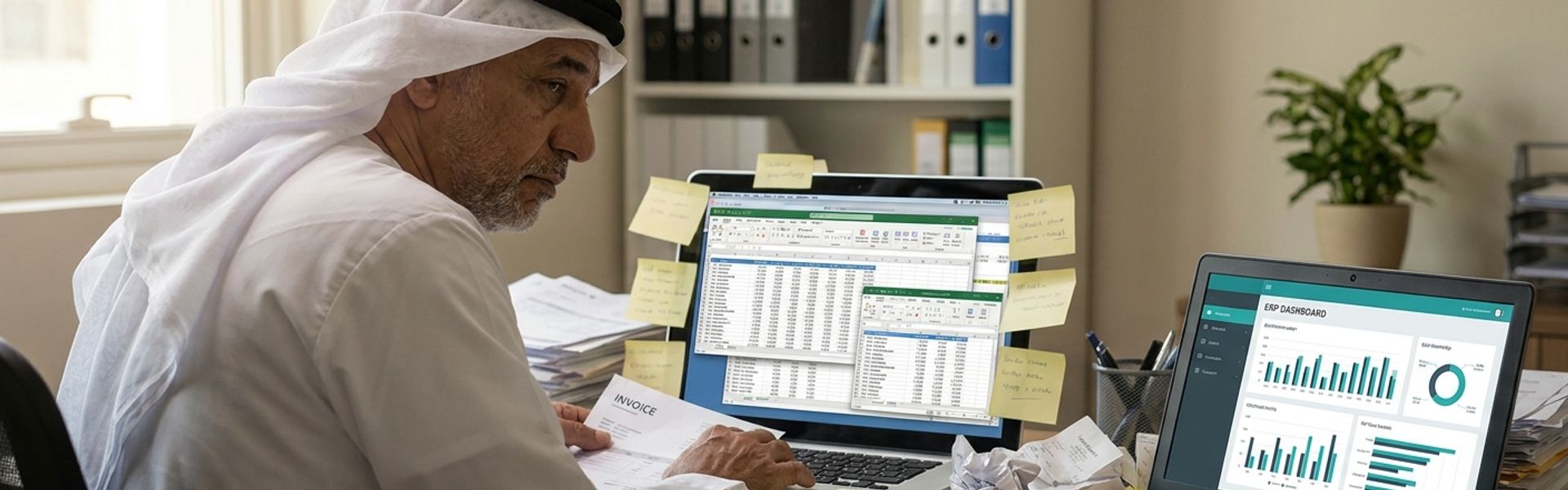
5 Signs Your UAE Business Has Outgrown Spreadsheets
Nobody wakes up one morning and decides their spreadsheet is broken. It happens gradually. The file gets slower. The formulas get more complex. The version on Ahmed's laptop doesn't match the one on Sara's desktop. And one day you realize that your 'temporary' Excel solution is now a mission-critical system that nobody fully understands and everybody is afraid to touch.
Here are five signs we see repeatedly in UAE companies that are ready for ERP — usually about 6 months after they should have switched.
1. You Have a 'Master Spreadsheet' That Only One Person Understands
Every company has one. It's the inventory tracker, the pricing calculator, or the project timeline that has grown to 47 tabs with 12,000 rows and formulas that reference cells three sheets away. The person who built it is the only one who knows how it works. When they go on leave, nobody touches it. When they leave the company, you're in trouble. This is a business continuity risk disguised as a productivity tool. In ERP, the logic lives in the system — not in one person's head.
2. The Same Data Exists in 3+ Places
Customer addresses live in the sales spreadsheet, the accounting spreadsheet, and the shipping spreadsheet. Someone updates one and forgets the others. An invoice goes to an old address. A shipment is sent to the wrong warehouse. A salesperson quotes outdated pricing because they're working from last month's price list. In Odoo, customer data exists once. Change the address, and every department sees the update instantly.
3. Month-End Closing Takes More Than 3 Days
If your finance team disappears for a week every month to 'close the books,' the problem isn't your accountant — it's your tools. They're manually matching purchase orders to invoices, reconciling bank statements line by line, chasing departments for expense receipts, and manually calculating VAT. With Odoo, bank reconciliation is semi-automatic (AI-matched), purchase orders link to invoices automatically, and VAT reports generate in seconds. Oakland's clients typically close monthly books in 1-2 days after go-live.
4. You Can't Answer Simple Business Questions Quickly
"What's our best-selling product this quarter?" "Which customer has the highest outstanding balance?" "How much inventory do we have across all warehouses right now?" If answering these questions requires pulling data from multiple spreadsheets and spending an hour building a pivot table, you've outgrown your tools. In Odoo, these answers are a dashboard click away — updated in real time, not as of last Tuesday when someone remembered to update the file.
5. You've Hired People Whose Job Is to Move Data Between Spreadsheets
This is the most expensive sign. You have an employee (or two) whose primary job is data entry: copying order details from the sales file to the inventory file, then to the accounting file. They're not adding value — they're acting as a human API between disconnected spreadsheets. Their salary (AED 5,000-8,000/month) is the ongoing cost of not having an integrated system. Odoo eliminates this entirely. One entry, all systems updated.
What Now?
If you recognized 3 or more of these signs, your business is ready for ERP. The good news: you don't have to rip everything out overnight. Oakland's implementation approach starts with the most painful area first (usually accounting or inventory), gets that running smoothly, then expands module by module. Most companies are fully transitioned within 90 days. Book a free assessment — we'll map your current spreadsheet landscape and show you exactly what changes and what stays.