How UAE Manufacturers Can Track and Improve OEE with Odoo
Most UAE manufacturers we work with can tell you their daily output. Very few can tell you their OEE. That's a problem, because output alone doesn't tell you whether your factory is running well — it just tells you how many units came off the line. OEE tells you how much of your equipment's potential you're actually using.
Oakland runs two factories on Odoo: ARMOR Lubricants (10 million liters annual capacity, 8 blending tanks) and ASAS Packaging (blow molding, injection molding, label printing). This article shares what we've learned about tracking OEE in a real manufacturing environment — not a textbook scenario.
What Is OEE and Why Does It Matter?
OEE (Overall Equipment Effectiveness) is a single percentage that captures three dimensions of manufacturing performance: Availability (is the machine running when it should be?), Performance (is it running at full speed?), and Quality (are the products coming out good?). OEE = Availability × Performance × Quality. World-class OEE is 85%. Most manufacturers, especially SMEs, run at 40-60% without realizing it.
The Three OEE Components
Availability: Is the Machine Running?
Availability = Actual Running Time / Planned Production Time. Losses include: unplanned breakdowns, planned maintenance, changeovers, material shortages, and startup/shutdown time. At ASAS Packaging, blow molding mold changeovers were taking 45 minutes. After tracking this in Odoo and standardizing the process, changeover dropped to 25 minutes — recovering 20 minutes of production time per changeover, which happens 3-4 times daily.
Performance: Is It Running at Full Speed?
Performance = (Ideal Cycle Time × Total Output) / Running Time. Losses include: reduced speed, micro-stops, and idling. The key insight: most factories don't know their ideal cycle time. They've never measured it. They run the machine at whatever speed 'feels right.' Odoo MRP lets you set ideal cycle times per product per work center. When actual performance drops below the ideal, you see it immediately.
Quality: Are the Products Good?
Quality = Good Units / Total Units Produced. Losses include: scrap, rework, and defects. ASAS Packaging's defect rate dropped from 8% to 5.2% after implementing in-process quality checks in Odoo. The improvement wasn't from better equipment — it was from catching defects after 50 units instead of after 5,000, and stopping the machine before raw materials were wasted on an entire bad batch.
How Odoo MRP Tracks OEE
Odoo Manufacturing tracks OEE through work center configuration. For each work center, you set: planned hours of operation (shifts), ideal cycle time per product, and expected quality rate. As production orders are processed, Odoo logs actual start/stop times (availability), actual output vs expected (performance), and quality check results (quality rate). The OEE dashboard in Odoo 18 shows real-time and historical OEE per work center, shift, and product.
5 Practical Tips from Our Factories
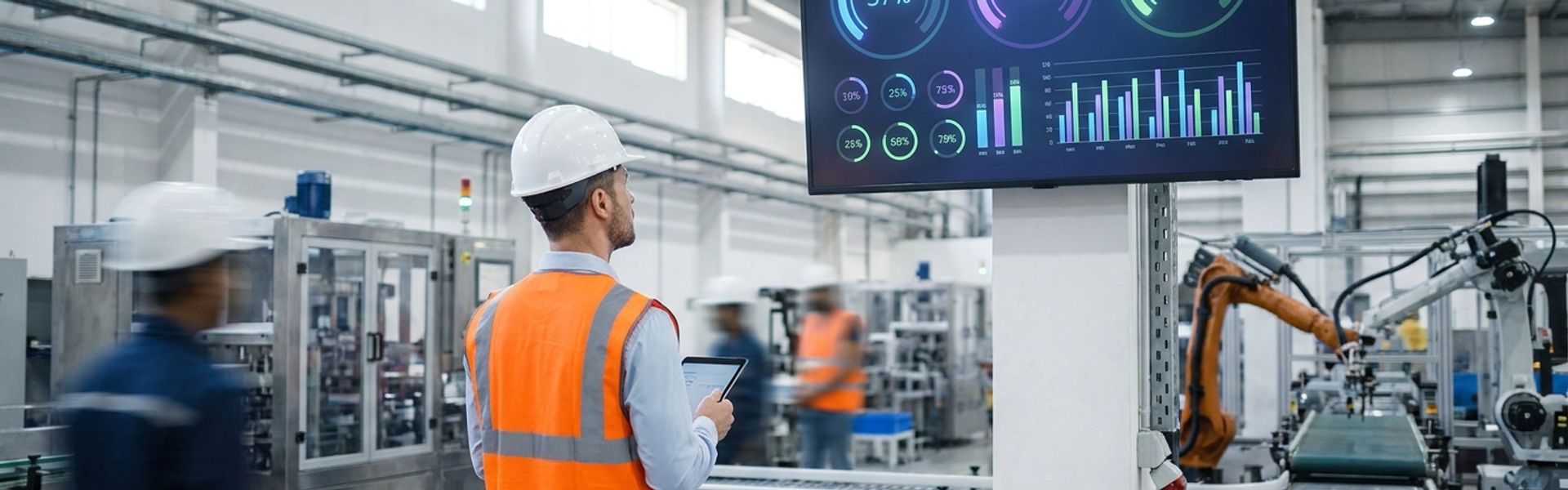
1. Start by measuring, not optimizing. Run OEE tracking for 4-6 weeks before trying to improve anything. The baseline data will surprise you. 2. Track changeover time separately. It's the single biggest hidden loss for most UAE factories. 3. Don't aim for 85% immediately. If you're at 45%, getting to 60% is a realistic first target. 4. Make OEE visible on the shop floor. ARMOR Lubricants displays the OEE dashboard on a TV screen in the blending area. Operators care about numbers they can see. 5. Connect maintenance to OEE data. When availability drops, it's usually a maintenance issue. Odoo's Maintenance module links directly to work center availability data.
Getting Started
If you're a UAE manufacturer considering OEE tracking, start with your bottleneck machine — the one that determines your overall output. Configure it as a work center in Odoo with accurate cycle times and shift schedules. Run production orders through it for a month. The data will tell you exactly where your losses are. Oakland can help you set this up as part of an Odoo Manufacturing implementation, or as a standalone OEE project for factories already running Odoo.